
Discover Hanoi - A Melliennia Of Culture
Hanoi is the capital and second-most populous city of Vietnam. The name "Hanoi" translates to "inside the river". The city encompasses an area of 3,358.6 km2 (1,296.8 sq mi), and as of 2025 has a population of 8,807,523. Hanoi had the second-highest gross regional domestic product of all Vietnamese provinces and municipalities at US$48 billion in 2023, behind only Ho Chi Minh City.
In the third century BCE, the Cổ Loa Citadel of Âu Lạc was constructed in what is now Hanoi. Âu Lạc then fell under Chinese rule for a thousand years. In 1010, under the Lý dynasty, Vietnamese emperor Lý Thái Tổ established the capital of the imperial Vietnamese nation Đại Việt in modern-day central Hanoi, naming the city Thăng Long, 'ascending dragon'). In 1428, Emperor Lê Lợi renamed the city to Đông Kinh, 'eastern capital'), and it remained so until 1789. The Nguyễn dynasty in 1802 moved the national capital to Huế and the city was renamed Hanoi in 1831. It served as the capital of French Indochina from 1902 to 1945 and French protectorate of Tonkin from 1883 to 1949. After the August Revolution and the fall of the Nguyễn dynasty, the Democratic Republic Vietnam (DRV) designated Hanoi as the capital of the newly independent country. From 1949 to 1954, it was part of the State of Vietnam. It was again part of the DRV ruling North Vietnam from 1954 to 1976. In 1976, it became the capital of the unified Socialist Republic of Vietnam.
The heart of Vietnam is a fascinating blend of East and West, combining traditional Sino-Vietnamese motifs with French flair.
MUST-SEE PLACES
TEMPLE OF LITERATURE

The Temple of Literature (Văn Miếu-Quốc Tử Giám) in Hanoi isVietnam's first national university, built in 1070 to honor Confucius and serve as a center for Confucianism and imperial education, featuring beautiful traditional architecture, serene courtyards, landscaped gardens, and the famous Doctoral Steles (stone tablets listing scholars) on tortoise pedestals. It's a significant cultural landmark symbolizing Vietnamese scholarship and remains a peaceful, historic site for both tourists and locals, offering a glimpse into Vietnam's rich intellectual heritage.
HOAN KIEM LAKE & NGOC SON TEMPLE

Ngoc Son Temple (Jade Mountain Temple) was erected in the 19th century in commemoration of Tran Hung Dao, the greatest military commander of the Tran Dynasty. With his military brilliance, Tran Hung Dao led the Vietnamese Army to several victories over the Yuan Dynasty in the 13th century.
The temple also pays homage to Van Xuong De Quan, the God of prosperity in ancient Chinese culture and Taoist philosophy.
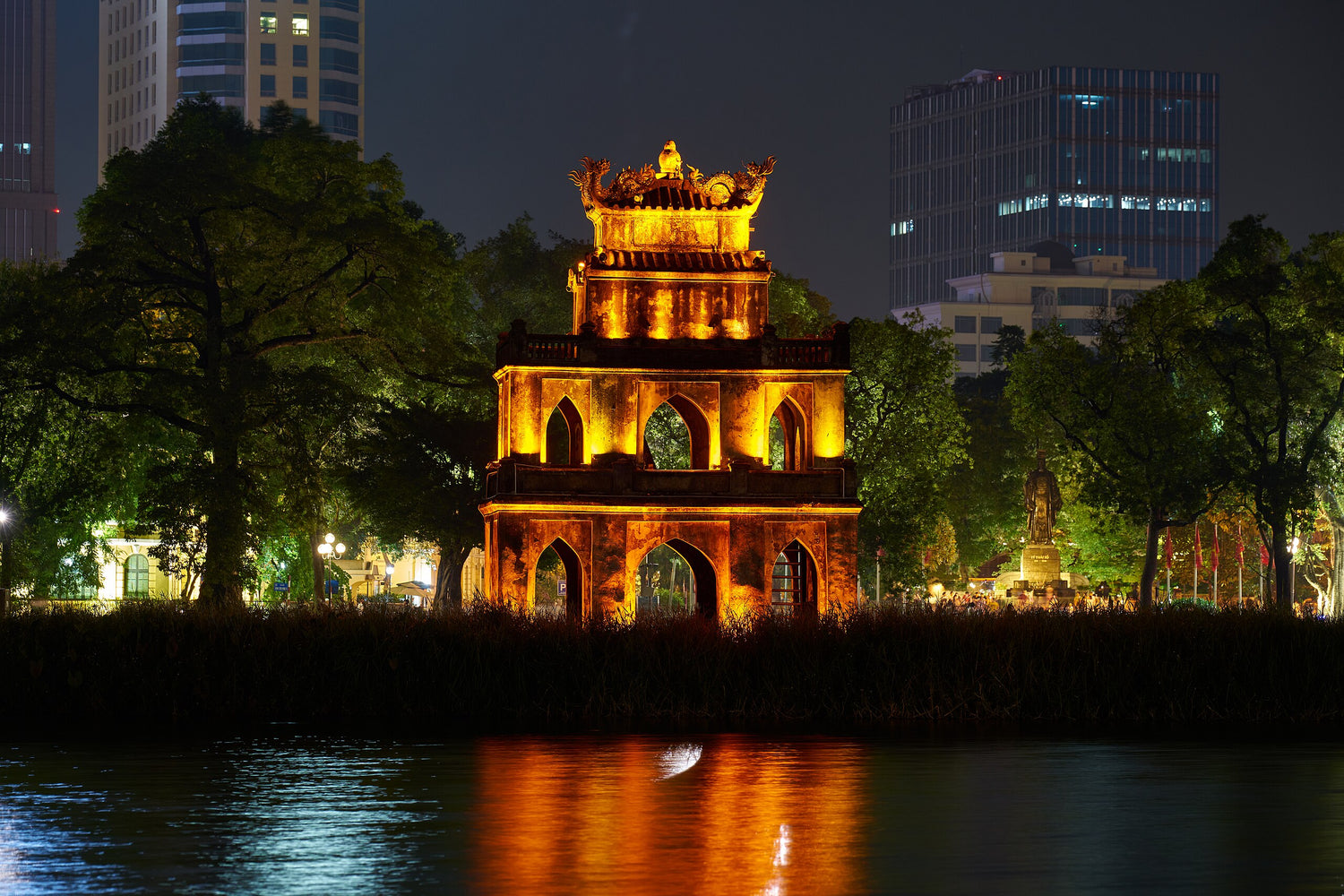
Hoàn Kiếm Lake, or "Lake of the Returned Sword," isa freshwater lake in the heart of Hanoi, Vietnam, central to the city's history and culture, known for the legend of Emperor Lê Lợi returning a magical sword to a golden turtle.It's a popular spot for locals and tourists, featuring landmarks like the Turtle Tower (Tháp Rùa) and Ngoc Son Temple, connected by a red bridge, and is surrounded by the Old Quarter and French Quarter. The lake is a hub for daily activities, from morning exercises to evening strolls, and is a symbol of Vietnamese independence.
HANOI'S OLD QUARTER

WEST LAKE AND TRAN QUOC PAGODA

Tran Quoc Pagoda, Hanoi's oldest Buddhist temple with over 1,500 years of history, wasestablished in the 6th century (541–545) during Emperor Lý Nam Đế's reign as Khai Quoc(National Founding). Originally located by the Red River, it was moved to Kim Ngu(Golden Fish) Islet on West Lake in 1615 due to erosion. Over the centuries, the pagoda not only served as a place of worship but also played an important role in strengthening Buddhism in Vietnam. In 1681, during the reign of Emperor Lê Hy Tông (1681–1705), the pagoda was renamed Tran Quoc, or “National Guarding”. This new name expressed the hope that it wouldprotect the nation from natural disasters and ensure prosperity and peace for the people.
West Lake (Hồ Tây) is Hanoi's largest freshwater lake, located northwest of the city center, and is a popular recreational area known for its scenic views, surrounding cafes, restaurants, and historical sites like Tran Quoc Pagoda.It's a peaceful escape from the city bustle, popular for jogging, cycling, and enjoying sunsets, with a 17 km shoreline that attracts both locals and tourists. About the history of the lake, West Lake was created from a curved part of Red River and appeared in several Vietnamese legends. One legend suggests that West Lake was shaped after the battle between Lạc Long Quân and a Ho Tinh (Nine-tailed fox), and that's why the lake was once called "Fox Corpse Swamp" (Đầm Xác Cáo). Another folk story claimed that original name of the lake was "Golden Buffalo Lake" (Hồ Kim Ngưu) because it was formed from struggle of a buffalo after the disappearance of her calf. In the 11th century, the lake was named "Foggy Lake" (Hồ Dâm Đàm) due to its misty condition. Ultimately its name was changed to "West Lake" in 1573 to avoid the given name of Emperor Lê Thế Tông, which was Duy Đàm.